3.1 Automated fencing dummy
3.1 Automated fencing dummy
Automated Fencing Dummy
The brief
Designed a purely mechanical fencing training station capable of simulating an opponent's attack, allowing fencers to practice defensive techniques without a training partner.
The problem
University projects often suffer from a lack of clear management. In a team of five friends, we became stuck in the "idea generation" phase. With only two weeks left and no CAD models started, the project was at risk.
I realized that I needed to step in. I created a technical roadmap, and split the machine into buildable subsystems so everyone could execute in parallel.
Some suggested I shouldn't include the original document I sent to my team because the tone was blunt. However, I believe it demonstrates my ability to take charge when necessary to solve problems piece-by-piece. We completed the entire project in under two weeks, earned an A+, and most importantly my teammates and I remain close friends because they appreciated the much needed direction.
View the full documentStalled project → delivered in 2 weeks
MCG 2101 · University of Ottawa · Winter 2022
Hard constraints
- Hold a standard foil blade and mimic human arm motion.
- Adjustable height and reach to fit roughly 95% of adults.
- Perform fencing movements: forward/back steps, lunges, and parries 2, 4, 5, and 6.
- Generate unpredictable sequences of five attack actions.
- Operate using mechanical mechanisms only — no electronic controllers.
Mechanical concept
Tip workspace & syringe actuation
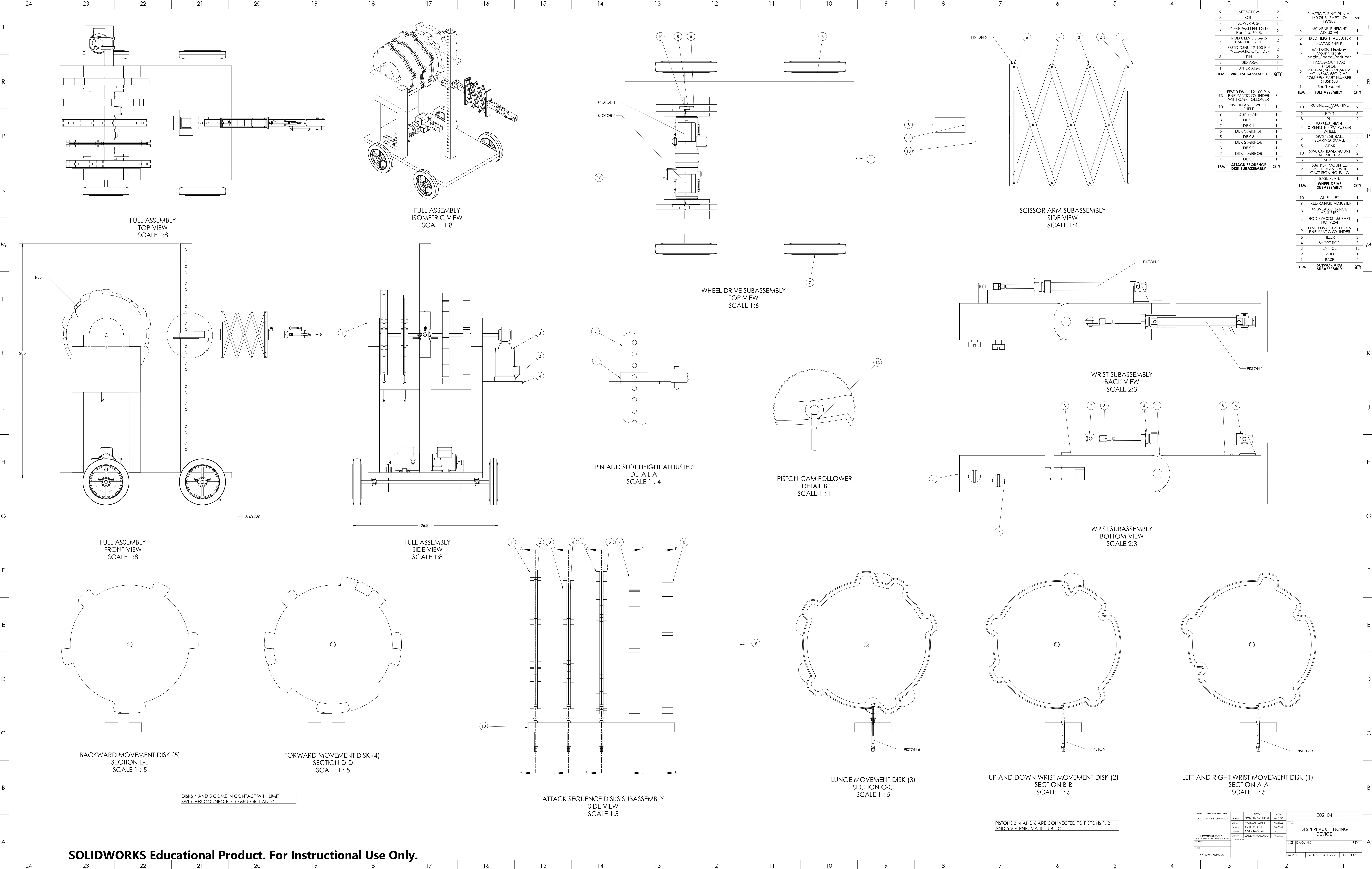
Parries 2, 4, 5, and 6 map to four corners of a square in foil-tip space — two orthogonal motions are enough to reach them. Pairs of syringes (hydraulic coupling) drive X and Y motion at the wrist; a spring return balances pressure where needed.
Lunge & reach
A scissor arm provides lunge extension (motor- or syringe-driven). Reach is set with a simple pin-in-rack (“gym rack”) adjustment so fencers of different sizes can use the same base hardware.
Rotating barrel cam
Five stacked plates on one shaft each drive a subsystem: wrist left–right, wrist up–down, scissor lunge, one forward step pulse, one backward step pulse — triggered by cams, syringes, and contact switches. Each plate is divided into five 72° sectors; each sector encodes one five-step attack phrase, so timing stays repeatable while combinations feel varied.
3.1 Automated fencing dummy
System integration & results
Complete system
The integrated machine uses one electric motor to spin a barrel cam that mechanically sequences every subsystem. As the barrel turns, plates push and release syringes and contact switches in order — producing unpredictable-looking attack phrases without electronics, sensors, or code.
The hard part was believable randomness from a purely mechanical controller; the multi-plate cam barrel was the compact answer.
System capabilities
- Four defensive blade positions (parries)
- Forward and backward stepping
- Lunge attack via scissor arm
- Unpredictable five-move attack sequences
- Adjustable reach and height
- Single motor, zero electronics
Leadership takeaways
-
Unblocked a stalled team
by providing clear technical direction
-
Broke complexity into subsystems
making the problem tractable for the group
-
Delivered under pressure
from stalled to A+ in two weeks